A fly fishing rod is really just a springy stick!
The movement of your casting hand(s) is amplified by leverage (the opposite of using a crowbar) into a much longer and quicker, but less powerful, motion at the rod tip. It is the rod tip that moves the fly line. In principal the quicker you can move the rod tip, the quicker it can move the fly line and (within limits imposed by other factors) the further you can cast. But that’s not the whole story. If you try to move the line with just a sudden jerk, the line will stretch rather than move initially. What you want is an even acceleration giving the line its own inertia. So, a fly rod is also a spring, when you move your casting hand, the rod spring bends against the drag of both the rod itself and the fly line being pulled at the tip. We call this Rod Load. When the spring recovers from this bending, the rod tip achieves the required acceleration and a greater final speed than it would if the rod had been just a stiff stick.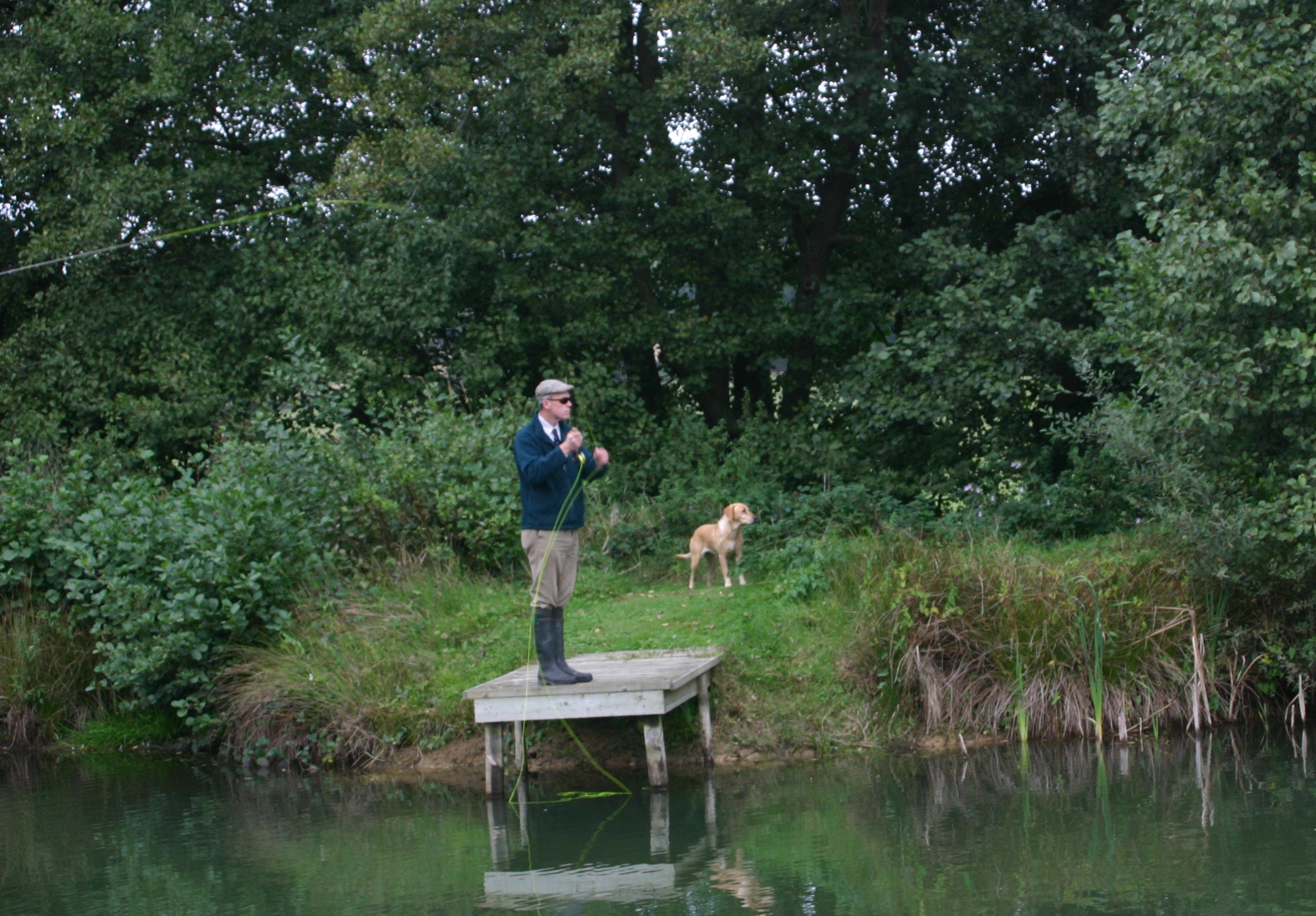
Choose a fly fishing rod to match the line you intend to cast
As I have said many times, something in the order of 30% of all the casting faults I get to iron out are caused by badly balanced tackle. So let me start with the most important factor which is that you should choose a rod to match the line you intend to cast and not the other way round. If you followed what I suggested in the line advice section you will hopefully have chosen the line weight which matched the weight and size of fly you intend to cast, so now you must choose the strength of the rod spring required to cast that line.
Line and rod must be properly matched or balanced, for optimum performance. Fly rods usually have their appropriate line rating marked on the butt section of the rod, just above the handle with either with the letters AFTM or a # sign, followed by a number or range of numbers. Unfortunately, AFTM line ratings (which correspond directly to the weight of the first 30 feet of the line excluding the 2ft or so of level tip) of fly rods is not always accurate because line weights vary from manufacturer to manufacturer within the same AFTM rating. Also your skill level, in so far as the amount of line you like to aerialise, will also affect the amount of loading you put on the rod.
So ground rules: First only buy a matched outfit from the same manufacturer, ie a rod that has been designed for the line or vice versa. Second be careful of rod and line combinations advertised as long distance outfits unless you are an expert caster. Too many of the rod and line reviews I have read (and even seen being tested) are written by experts who can aerialise possibly (or maybe probably) far more line than you! In my experience, the American manufacturers are very bad at this and tend to under-rate their rods, which often work better with line sizes one or two heavier than indicated. So third, if you are in any doubt, always try it before you buy it
Then choose how long a rod you want…
So, the longer the rod the better? Up to a point, yes… But, in practice, the length of your ideal fly rod will be limited by your strength. A longer rod has a lot more bulk to move through the casting stroke and therefore more effort is required to achieve tip speed. It actually works against your wrist and arm muscles. Single handed rods of much over 9ft 6in might give you small casting height advantage (and possibly a tactical advantage) but they are much harder to cast and will be very tiring over long periods. Incidentally, this is why for salmon fishing when we need long rods and powerful springs we use two handed rods. More on double handers later on.
A shorter rod will make it easier to achieve greater tip speed but give you less distance in which to accelerate and less height above the ground and water to shoot line. So getting the balance right is important for you and your size & build.
So, as a general guide to getting a single handed rod: I would suggest Kids should be casting a rod length of less than 8ft, Ladies & anyone without good wrist strength 8ft – 9ft, Men 9ft – 10ft.
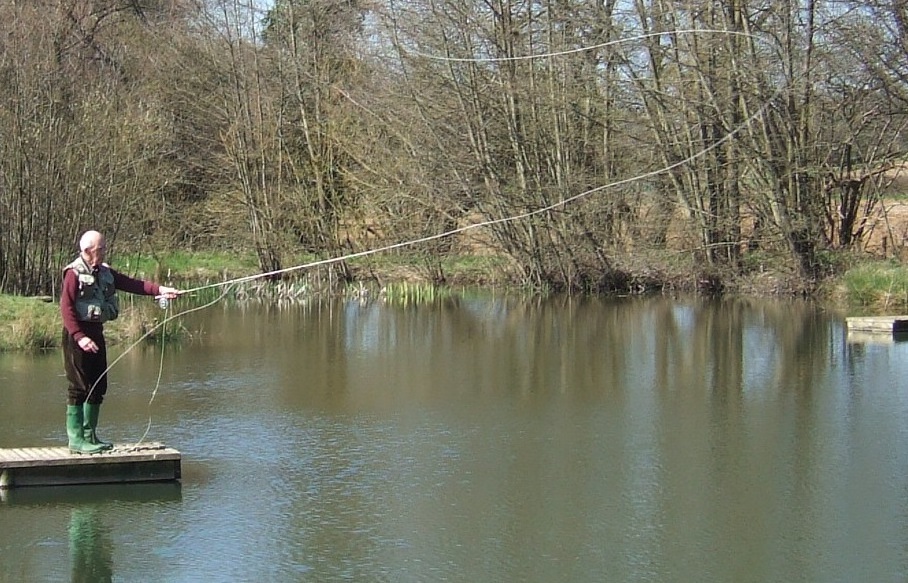
What a good example of this: Here is David M at the age of 91 casting a nice line on my lakes at the farm with no effort!
Choosing a double handed salmon or Spey Rod
When choosing a double handed salmon or Spey Casting rod you should still follow the same advice above, ie start with the line then move onto the rod strength but into you equation you must add two more factors. How long a line will you want to put out? And will you be wading?
With regards the line, you may be fishing on small to medium sized rivers for which you will only need line head lengths of say 13 – 15mtrs. If you fish on medium sized rivers you may want a head length nearer 20mtrs and on bigger rivers even longer. So you must take into account the overall weight of the casting head of the line and not just the AFTM rating, which is as you may remember only the first 10 yards of line.
Then if you are wading, height above the water gives you a significant advantage to hold bigger Spey casting loops out of the water, BUT the longer the rod the greater the effort required so be careful that your rod length is not too much for you.
So again a generalisation but as a guide: Small rivers, kids and those with less wrist strength a double hander of 13 – 14ft will be fine. Medium sized rivers and most fishers 14 – 15ft. Big rivers and strong casters 15 – 16ft. By the way you may see guys (yes they are mostly guys) taking part in tournaments with rods of 17-18ft but these are way beyond normal mortals like you and me and I have been present (in fact judging) on two occasions when a competitor has suffered serious injury as a result of casting this very heavy gear and these guys train like athletes for these events.
Choosing the right rod action
Rod actions for both single and two handed rods fall into two basic categories: Tip action (can be called tip-flex or fast action) or Through action (Which can be called progressive or mid-flex) Broadly speaking, the tippier the action, the stiffer the main body of the rod will be and the tighter the loop the rod will cast, but the better the caster you must be to get the best from it. The more mid-flex the action the easier the rod is to load but the greater the likelihood of too much over bounce or follow through, which will open your loops and reduce distance.
The trend in recent years has been towards ever stiffer and more tippy blanks, I think because a lot of the manufacturers use experts to design their rods. Trouble is the expert casters have the skills and wrist strength to load and control these stiffer rods but the average fisher does not.
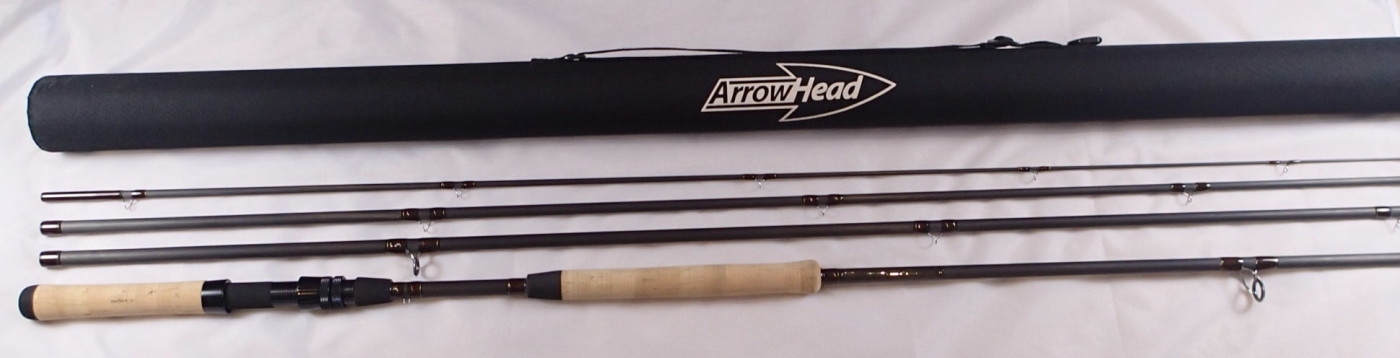
My ArrowHead rods are not designed this way. They are designed with years of experience of producing rod and line combinations that are easy to cast. The secret is actually the very opposite of what a lot of manufacturers produce. Instead of being stiff in the butt and flicky in the tip, they will bend easily at the butt end but then are actually very firm in the tip. This means that you will feel the rod load but still cast a nice tight loop as the tip resists following through at the end of the casting stroke. This is why so many people rave about my Arrowhead rods over countless other more expensive makes.
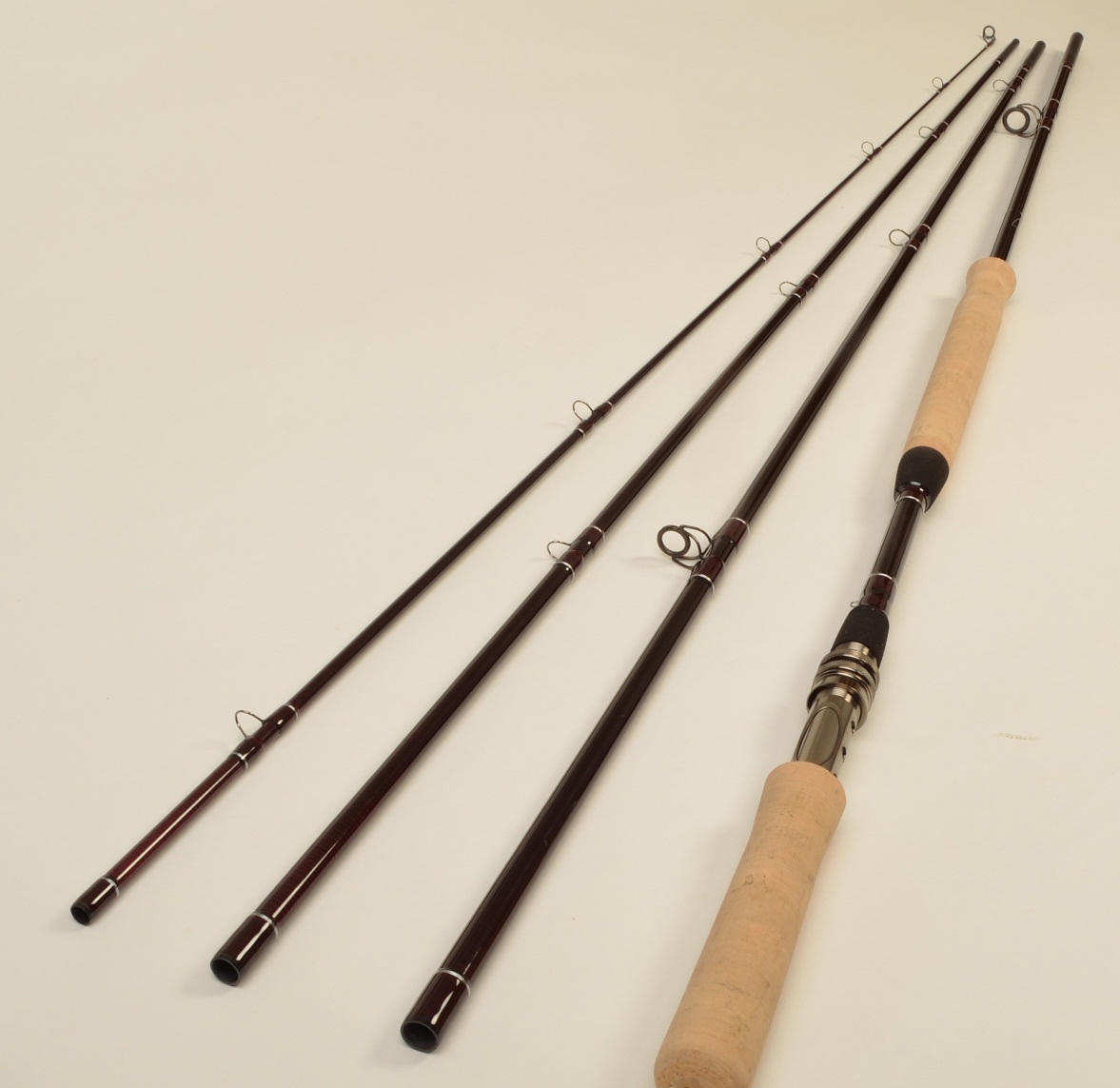
You might also notice that on my double handed rods I even leave off the cork (and more importantly the glue) at the primary flex position so as to get the maximum bend from the handle section. This is because the Spey or Roll cast loops do not pull and load stiffer rods as much as the inertia of the back cast of an overhead cast will do and the easier it is to get the rod to load fully the easier it is to cast. So my advice is always to choose a more mid-flex action anyway if you are intending to roll & Spey cast with single or double handed rods.
SO WHY ARE SOME RODS FAR MORE EXPENSIVE THAN OTHERS?
The cost of a fly rod is made up of the blank, the fittings and the finish and of course the labour cost in all three.
Most modern fly rods advertised as being made of Carbon are a bit like your supermarket “pork sausages”, in that the amount and quality of the Carbon cloth in them varies as much as the amount and quality of the pork in various brands of sausages.
Good quality carbon cloth is expensive. Ok and yes so is the skilled labour that rolls them and grinds them to produce the finished blank. But the biggest effect on the end price is the material costs. Cheaper rods tend to have rather more fibreglass in them than Carbon, because the poor quality carbon cloth needs more fibreglass to hold it together.
The labour element of rod building might be thought of as being much cheaper in the far east these days but actually if you take into account shipping costs, the labour element of building a rod is no longer the major factor in determining the end price.
The Rod fittings will make a significant difference to the end price with rings, reel seats and cork available in a very wide variety of both quality and cost.
The finish is merely an added labour cost depending upon whether the rod is un-ground (ie left with the blank rolling ridges) or ground smooth, such as in my Standard ArrowHeads, or then lacquered or varnished such as in my C-Scrims.
My attitude to designing rods is fairly similar to my attitude when building anything. It takes the same amount of time to build something using quality materials as it does with rubbish. The difference is you shouldn’t have to ever rebuild the quality materials but the rubbish soon fails.
So, WHICH ARROWHEAD ROD?
ArrowHead standard range 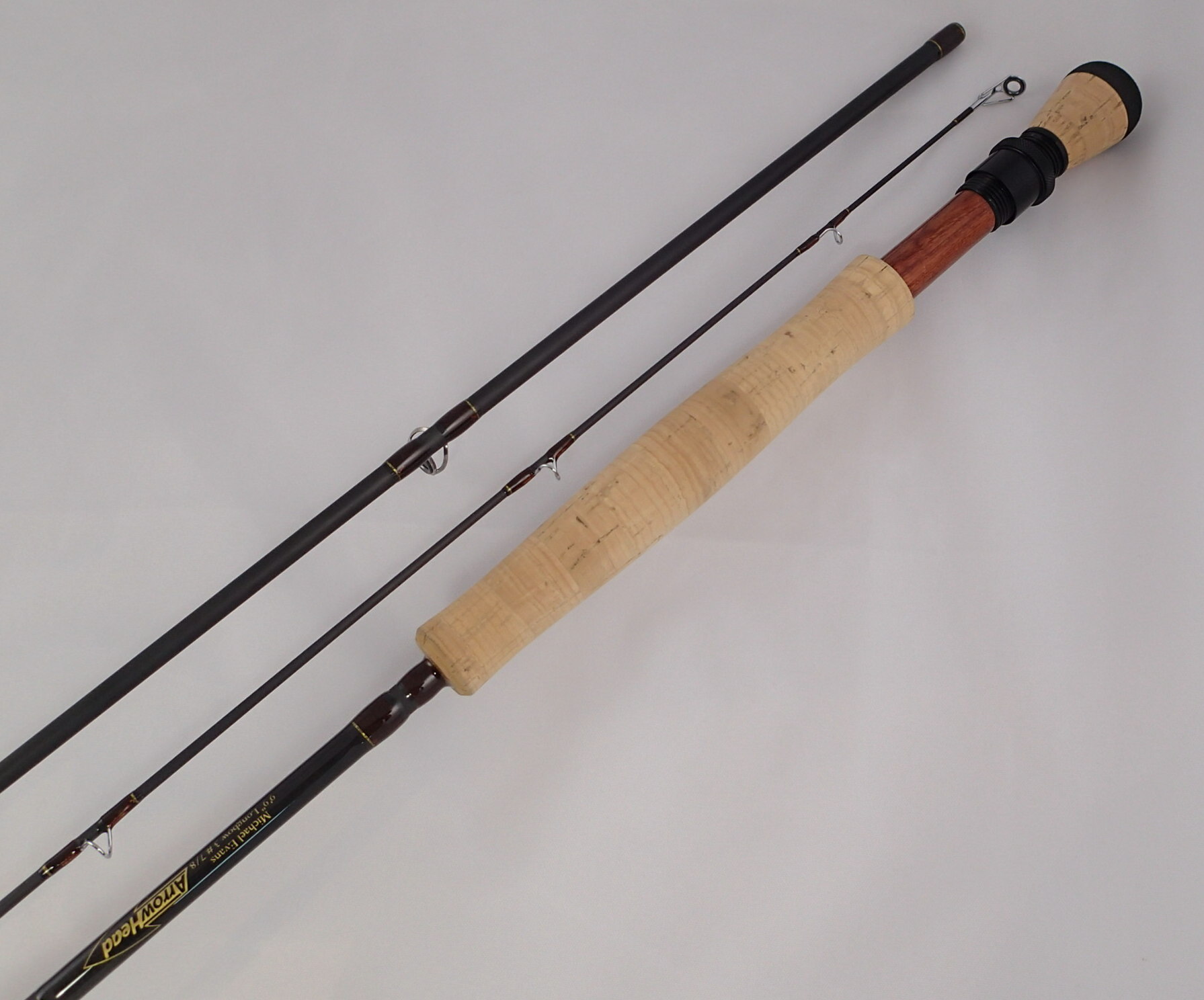
Quality traditional build using a high grade carbon cloth and light fibreglass scrim. These rods are then fitted with good quality rings, cork and reel seat and ground to a smooth matt non flash, no frills finish. I like to think of them as the work-horses. Sound and reliable.
The ArrowHead standard range includes both my single handed trout rods, single handed saltwater rods and my double handed salmon rods. They combine reliability with value.
ArrowHead C-Scrim – the latest state-of-the-art British carbon technology
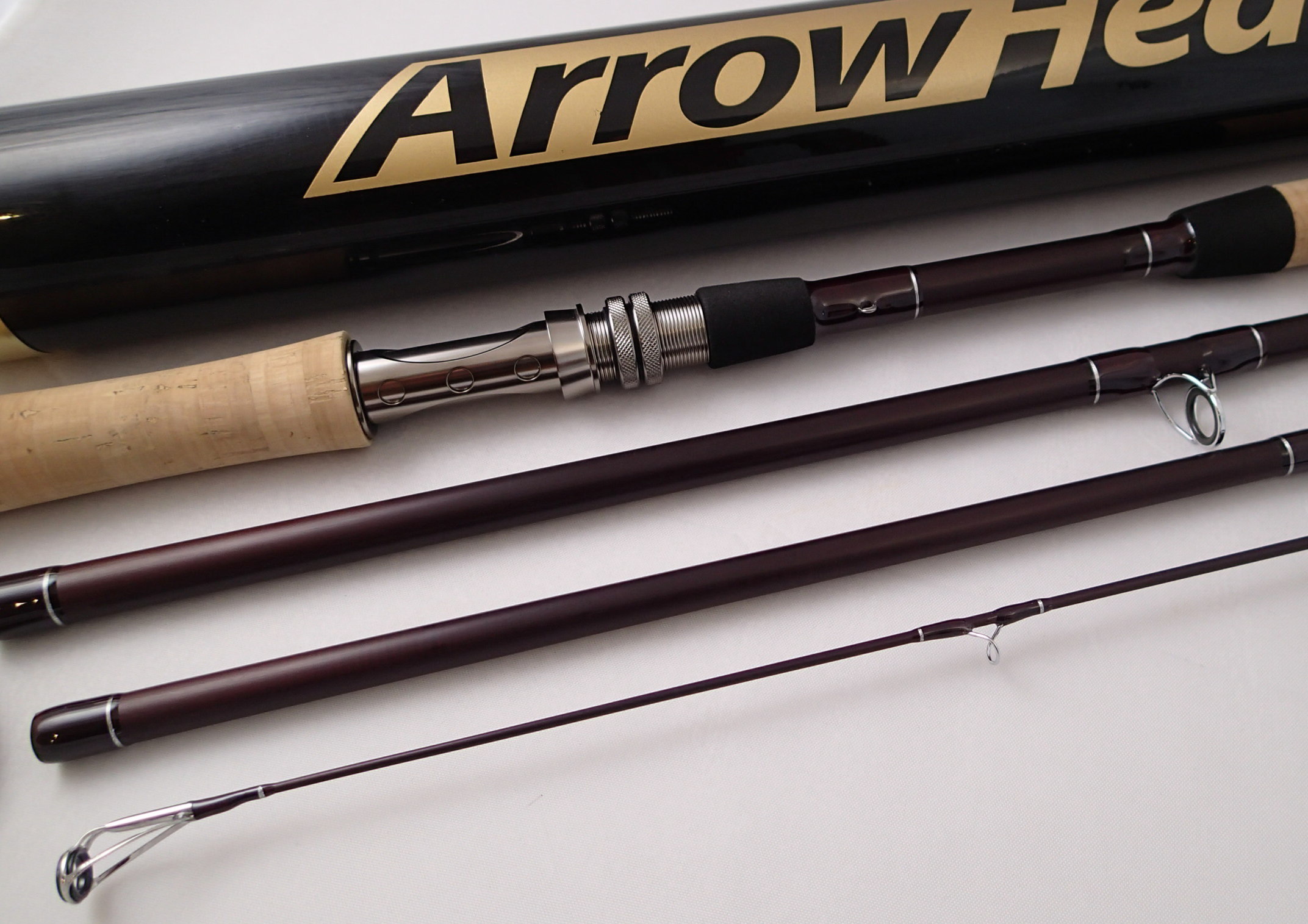
The C-Scrim technology is the latest breakthrough in the manufacturing process for the blank. The carbon cloth roll is reinforced, not with fibreglass but with an outer scrim made from a different type of carbon cloth and held together by a much improved resin or glue. This makes the rods lighter for the same strength. But yes, this process in terms of materials alone is much more expensive to produce.
For the most expensive technology it then seemed logical to go for the very best rings, cork and reel seat.
The 2015 versions now have a very attractive powder coated finish which gives a great look but still less rod flash than high gloss. After all its no good looking good if the thing frightens off the fish!
The ArrowHead C-Scrim rods are now available in the 9ft 3ins single handed trout version and my three popular SpeyCaster double handers the 13ft 6in, 15ft and 16ft.