Loops
A loop on the end of your fly line makes changing leaders easy (and a very streamlined connection). One can either needle knot a permanent heavy piece of nylon to the line and then tie a suitable loop knot (e.g., figure-of-eight), or you can attach a braided monofilament loop to the end of the fly line using the sleeve and super glue technique, or you can taper and fold the fly line and whip a loop into it using a fly tying bobbin holder.
Leader or Tippet (Casts)
The leader or tippet, these days – preferable to the older, but ambiguous term ‘cast’ – is the length of material attached to the front end of the fly line. The fine end of the leader, to which the fly is tied is known as the point. If the leader has short side branches off it, to which flies can be tied, these are known as ‘droppers’. There are various materials used for leaders and tippets.
The job of the leader is to separate the very visible fly line from the fly. It must be constructed to give the best possible continuation of the ‘turnover’ of the fly line (so as to distance the fly from the end of the fly line), while fulfilling certain other practical fishing requirements. The tippet (point) of the leader and knots are the weakest part of the connection between the angler and a hooked fish and must, therefore, be strong enough to land the quarry without an unduly prolonged fight. Fishing too fine is unsporting, in my view, and I have never understood those who consider it clever to attempt to land large fish on precariously fine tackle.
Some anglers go to considerable trouble over leader design and there has been much published in books, in articles and on the internet dealing with this subject. The following will suffice for a beginner, but you will undoubtedly seek refinements as your knowledge and tastes develop.
Small still water trout 5ft level 8lb + 4ft level 6lb (9ft overall), or tapered 9ft ready made to 6lb point
Early season reservoir 4ft level 10lb + 3ft level 8lb (7ft overall)
Drift fishing loch style 4ft 10lb + 4ft 8lb (dropper) + 3ft 6lb (dropper) + 3ft 4lb (12ft overall)
Chalk stream 9 – 12ft factory made tapered leader to 3lb point
Leaders for Salmon Fishing
For salmon fishing you will need heavier leaders both because you will be fishing in rocky rivers for big fish but also because heavy and more air resistant flies cast better on heavier nylon of Fluoro Carbon. Also please note Fluoro Carbon is approximately 2/3rds the diameter of nylon for the same breaking strain and because abraision resistance is what you need, not just breaking strain I use much heavier Fluoro Carbon than I would nylon. The reason I like Fluoro Carbon is that it absorbs water and sinks faster.
So again as a rough guide:
Flies 16 – 12 in low clear water, I use 12ft of either 12 – 15lb Maxima nylon or 15 – 20lb Seaguar Fluoro Carbon.
Flies 8 – 12 and small tubes in average water, I use about 6 – 8ft of 15lb Maxima or 19 – 25lb Seaguar.
Flies 6 and bigger including heavy tubes, I use 4 – 6ft only of 20lb Maxima or 25 – 30lb Seaguar.
Note that if using polyleaders to sink the tip of the line your leader or tippet should be much shorter for the smaller flies otherwise they will not sink properly and also the fly will hinge badly when casting.
Types of material
Nylon Monofilament
In my opinion, still the best all-round leader material, where there is a high risk of abrasion (e.g., rocky rivers). Standard nylon mono has plenty of stretch and seems to be less critical of a poorly tied knot than other kinds of leader material and more forgiving of errors when playing a fish. MAXIMA is still the very best, I think. I prefer colourless or pale green in trout sizes and ‘chameleon’ (brown) for salmon fishing.
Fluorocarbon Monofilament
An alternative to nylon, Fluorocarbon has a higher density than nylon and therefore sinks more readily. Its refractive index is closer to that of water, so it is purportedly less visible under water. Fluorocarbon is very thin for its strength, but expensive.
Pre-Formed Leaders
Tapered pre-formed leaders have the edge over made up, knotted, leaders for turnover and presentation. One usually knots on a tippet and replaces this bit when it becomes consumed through changing flies. More expensive than home-made, especially if you have an off day with the casting!
Polymer/ Braided Extension Leaders
Used as an additional section between your fly line and leader tippet, poly-leaders are not as essential as some advertising might have you believe. Under certain conditions, they can be a damned nuisance. An extension leader that is not balanced to complement the existing taper on the fly line can adversely affect turnover. Extension leaders really have two uses: 1) to turn a floating line into a variable rate sink tip; 2) to provide extra tapering to improve turnover and presentation. These days braided leaders have (thankfully) been replaced by solid polymer leaders which when made by Airflo are trade named Polyleaders. Airflo make my leaders for me and so I am permitted to use the term in my own brand Polyleaders.
Backing
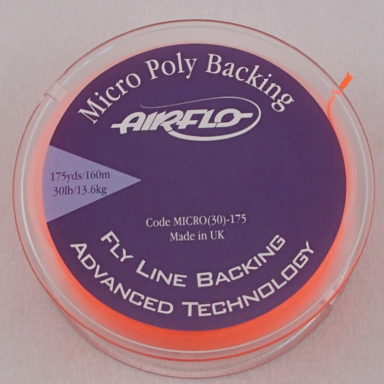
Backing is the reserve line you have on your reel attached behind your fly line. It’s insurance in case a big fish should run out further than the length of your fly line. Some types of backing are also used as a shooting/running line as an aid to casting, usually with short lines or shooting heads. There are several types of material used.
Nylon Monofilament
Excellent shooting qualities for shooting heads and relatively cheap. You can get more mono onto the reel compared with most braided materials. It does tend to tangle (terribly, sometimes), so wouldn’t be my choice.
Twisted Terylene
Cheap rot-free backing. Quite thin, so you can pack lots onto your reel. Has a tendency to kink, though.
Braided Dacron
Strong and limp. Traditional backing material favoured by many.
Braided Nylon Monofil
Very strong, with good shooting qualities, but bulky (can also be used to make your own leader loops).